There are two seasons in Panama: the dry season and the rainy season.
Rainy season does not mean “Mosoon”! It simply means, it most likely will rain in the afternoon. the morning and noon time are usually sunny. Around 13:00 to 15:00 (1 to 3 pm) it clouds over, and rain will fall.
Right now is the dry season on the pacific side of Panama. That season usually starts around mid- to end of December, and lasts until mid-April.
Dry season also is the time when many bushes and trees flower. Here are pictures of a few examples…
Bougainvillea
Pink Guayacan Tree
Bougainvillea in Santiago, Veraguas - Arosemena Park
Today, we left Santa Catalina, Veraguas, around 4:30 in the morning, to drive to Camarón Arriba, Chiriquí.
When we left, the car reported 24C (75F). when we reached David, the capital of Chiriquí, around 9:30, the temperature had already climbed to about 29C (83F). When we left David around 14:45 (2:30 pm), the car showed 39C (103F). La Concepción (capital of Bugaba district) was about 2C (4F) less hot.
When we left La Concepción around 18:00 (6:00 pm), it was still 32C (90F). And when we reached my house at 700 m altitude in Camarón Arriba, the temperature was already down to 27C (80F).
I do like warm, and I don’t mind really warm, but when the temperatures rice to the upper 30sC (upper 90s F) and above, it gets a little too hot, even for me! 🤪🤷♂️😝
Well, this trip just reconfirmed for me, that Camarón Arriba is ideal for me: the temperatures hardly reach 30C during the day, and drop to 20C at night (86F and 68C respectively). Perfect!
Such a cool feature of Panama, to be able to choose the ideal temperature range for you, simply by moving higher or lower on the mountains…
As I’m getting older I seem to have less and less energy. I already felt the onset when I was trying to renovate the house in Wilmington all by myself, in an attempt to proof to my then wife how much I cared about her. Well, she didn’t get the message… And i blew, it seems, my last reserve of energy…
Today, I’m working on building two houses here in Panama. And it’s getting harder and harder to get going every morning…
The house in Chiriquí is about 4 to 5 weeks of work (with hired workers) away from being able to be put on the market. I’m hoping some nice folks to have as neighbors will find it, and enjoy the very unique architecture features and serene country setting, up high enough to have warm (not hot) days and cool nights. Despite the materials and labor costs having risen quite a bit over the last year and a half, I’m still thinking of being able to sell it for 150K - much less than the usual homes suitable for foreigners.
Backside of the house, as seen from the street
Huge terrace - the living room, dining room, and kitchen all at once
Guapo, my trusted worker. Front view of the house
Well, first I need to get it finished, though. And for that I need to get back to Chiriquí…
Currently, we’re in Santa Catalina, Veraguas. one of the best surf spots in Panama. Iris‘ house is really close to being able to make use of it. Really close, but not yet quite there…
Iris - family outing with dogs at playa estero
skin and bones! no matter how much I eat
Happy to take few hours off
Due to the countrywide protests it’s even more difficult to get materials and workers, as movement is very restricted. So I’m forced to try to work on my own…
I’m supposed to tile the livingroom/kitchen, sonIris can do the grouting. And I’m trying to build out one room upstairs, so we have a lockable space to store tools, materials, and other household stuff.
This morning, though, i woke up with the desire to bake Vanille Kipferl - one of the many traditional Austrian Christmas cookies. Iris encouraged me, too, to bake. She always seems to know what i really would like tondo, and asks me to do that. So, today, i baked these cookies, that used to be my longtime favorite sweets around christmas.
We bought a new stove last year. A mid-level style, I guess, as it was not cheap and also not one of the expensive ones. However, it doesn’t have convection fan. Nor does it have upper heat, but only from the bottom. the dial gives temperature ranges, just to make it even more challenging!
However, given this stove and the fact i haven’t baked Vanille Kipferl in probably decades, they turned out bastante bien (quite well).
Proof of that is the fact that for desert at lunch we devoured already 1/2 of what I made!
A former colleague at a job long ago asked me: “Why Panama?”.
I thought i simply send a link to the blog post that explains it. But to my great surprise, i hadn’t written it yet! 😝
View from the terrace…
Well, here we go…
I had only very few important criteria when considering retirement locations:
Warm, safe, affordable, tranquilo (my new favorite word), able to visit my parents relatively easily, availability of good food, availability of visa.
The southern US immediately disqualified, as it is NOT a safe place, with all the people running around with guns and using them. And it is way too expensive. Well, the political situation is also far from encouraging.
So, with that list in mind i checked out several other countries.
Europe is too cold - i do not want to see snow ever again in my life - except on fotos.
Southern India would have been really nice! But, India has no visa.
Dominican Republic is too loud - everybody and their grandmother has a huge boombox outside their door blasting anything they feel like into the air; and that at all kind of times night and day.
Tobago - where i had lived before for 4 years - is too expensive. I don’t want to spend all my savings on housing. So are most of the other small Caribbean islands. And the big ones have way to high a crime rate.
Most of Africa and Middle East is politically too instable, or even in a war. So is Africa. I do not want to lose all my savings and have to start over again!
Thailand and surrounding countries have a language that is impossible for me to learn.
Leaves northern South America and central America.
Most of the countries in that region are also politically rather instable or in some kind of civil war like unrest.
Only Panama seems politically stable.
It has visa regulations that are very conducive to immigrate.
The real estate is quite affordable (you can get land for less than 10$/m2 [1$/sqft], and buy a good home for 150k [the one I’m building for example😝]).
The language is close enough to english to be able to eventually learn it.
The climate is awesom - you can choose your preferred temperature range by going higher up on the mountain or closer to the sea (at my land it rarely gets above 30C [86F] and rarely below 19C [64F].
I can grow much of my favorite food myself - the growing season is 12 months a year. Vegetables and local produce and products are quite affordable, too.
And, it is not much more costly to travel to Europe to visit my parents, than from the US.
My land is at the end of an asphalted dead-end road that leads up the mountain. It’s very quiet here - muy tranquilo!
Perftect!!!
Of course it has its downsides as well. But i can deal with and work around those…
I have written about each of these items (good and bad) before in this blog. I hope you enjoy poking around… If there’s a question that isn’t addressed yet, please let me know, and I’ll write about my experiences and observations on that topic…
I was always blessed with new ideas. Usually years before the “world was ready” for them. This is a blessing and a curse. The blessing, obviously, is that such ideas are exciting and fun to ponder. But, pondering alone never seemed sufficient for me, I always wanted to implement them, too!
I (choose to) believe, that “sending ideas” is one of the three ways the greater universe (or whatever you want to call whatever is outside of the physical system we live in - our universe) is influencing this system (our universe). I find it hard to believe that ideas just come from the neurons flying around my little, limited capacity brain… (Coincidences, and the fact that every person seems to have a passion, a topic that is very dear to their heart, are the other two outside influence I was able to observe (more on spiritual ideas, fulfilling live's purpose, and finding happiness here: toolOfTheUniverse.org).
The world seems to be functioning quite well as it is. But, then, there’s an idea that somebody receives. A foreign item. Something that wasn’t there as of yet. The system was operating without it. But now, as this person gets this idea, it is possible that it becomes part of this system. And the course of our world is forever changed. No matter in what little way…
On the terrace of the home I’m building in Chiriquí the mason trying to lay tiles had the first tile slanted just a little - maybe 1 mm. Trying to keep all the other tiles level with this one, by the time his line reached the other end of the area 4m down the line, he ended up needing 4 cm of padding! Any little thing now can - and most often does - have a big impact later on!
Ok, back to my ideas…
The wonderful thing about receiving ideas is that it’s exciting. The downside of it is, that if an idea is a bit farther out than the general population can appreciate, it’s hard to find somebody else who would partner in implementing this
For example:
In the later part of the 80s I had the realization, that most of a relational database application - which most business application are still today - is made up of the same kind of program. The only difference in the various programs of any single type are the name of the table and the names and numbers of fields. There is also most often more or less of business logic for each of the tables, which differs a lot from one table to the other - but that is a comparably small portion.
So 35 years ago I implemented a first program generator. A program that writes the 4, 5 different types of programs needed for every table. It also linked the programs according to the relationships of the tables, created menus, and provided the hooks for business-logic, printing, and so forth.
That generator was the reason why Progress Software hired me in 93 - finally realizing my dream to move to the USA! Unfortunately, the new CTO, who started between my being hired and my actually starting with them, didn’t appreciate the idea - as was so often the case in my life… The project was cancelled, and I ended up working on something else…
BTW, Object Oriented Programming seems to be another approach to deal with the same problem: repetitive code. My experience is, though, that changing from procedural to object oriented approach did not make writing and maintaining programs easier at all. I’ve come to the conclusion, if you really want to create a mess, use object oriented programing! Without being very consistent in your naming of things and structuring your classes, a system becomes exponentially harder to maintain the bigger it gets. Larger system are virtually unmaintainable! At least those I encountered were so…
In the early 2010s I used the same approach as earlier on in my life to create a browser based application. I consider this application “my Mona Lisa”. After years of changing - not just the programs and DB structure, but even the whole focus of the application! - the system is still neat and consistent and super easy to maintain and expand! This application proves it is possible, it proves it is much less costly to build, and it proves to solve the typical problems systems are plagued with: hard to maintain, hard to extend, hard to adjust, hard for somebody new to understand and get into, high bug rate in code from get go and even higher once modified.
How is that possible? Estimated 80% of the code is generated and can easily be regenerated when there are DB structure changes. These programs are basically self-maintaining. The customized, manually written code is super-consistently following the same naming conventions and style as the generated code. That makes it very easy to understand, which in turn makes it easy to modify and extend.
I implemented this approach for procedural OpenEdge code. But, it can be used for any other language and many other styles of programming as well.
Personally, I don’t think we are able to deal with the complexities of the ever growing systems without the help of computers… computer programmed code is super consistent. Consistency makes life easier for not just people, but for computers as well…
Today, as I am retired from programming, I am working in a totally different area. But, I am, again, trying to implement ideas, new approaches.
I observed the architecture of homes in Panama. And it quickly became clear, there’s plenty of room for improvements!
The focus of local, Panamanian architecture is “cheap”. While it is fulfilling certain criteria well, there are tons of compromises about functionality and comfort. Too many for my liking!
For the foreigners, the architecture of northern areas is simply copied. There are problems in the north that simply don’t exist here - extreme temperatures is just the biggest of them. And there are problem here, that simply don’t exist in the north - super high humidity, just to name one of the biggies. Northern architecture provides solutions for northern problems. But not just NOT provide solutions for tropical problems, but even causes problems in tropical areas.
Using all the ideas and approaches I have encountered over the course of my life, adding my observations and experience living in a tropical climate, and - yet again, as usual - receiving many ideas, I am trying to create a home in Chiriquí that is comfortable and functional, affordable, makes use of and benefits from the local resources and climate, and deals with the local problems.
As if that is not exciting enough, it all is happening in a new, different language, and in an unfamiliar, different culture!
Despite being very busy and occupied by that big task, I’m trying to find the time to blog a little about it. idea.
My first house is taking shape already. So far, many of the ideas and approaches used are validated already! The topics of heat, humidity, type of foundation are just the biggest items on the list that are taken care of. Not by trying to fix the symptoms of the problems with the architecture by simply adding a/c, dehumidifier, and patching cracks in walls and floors. But, by having the appropriate basic architecture to deal with these problems from the get-go!
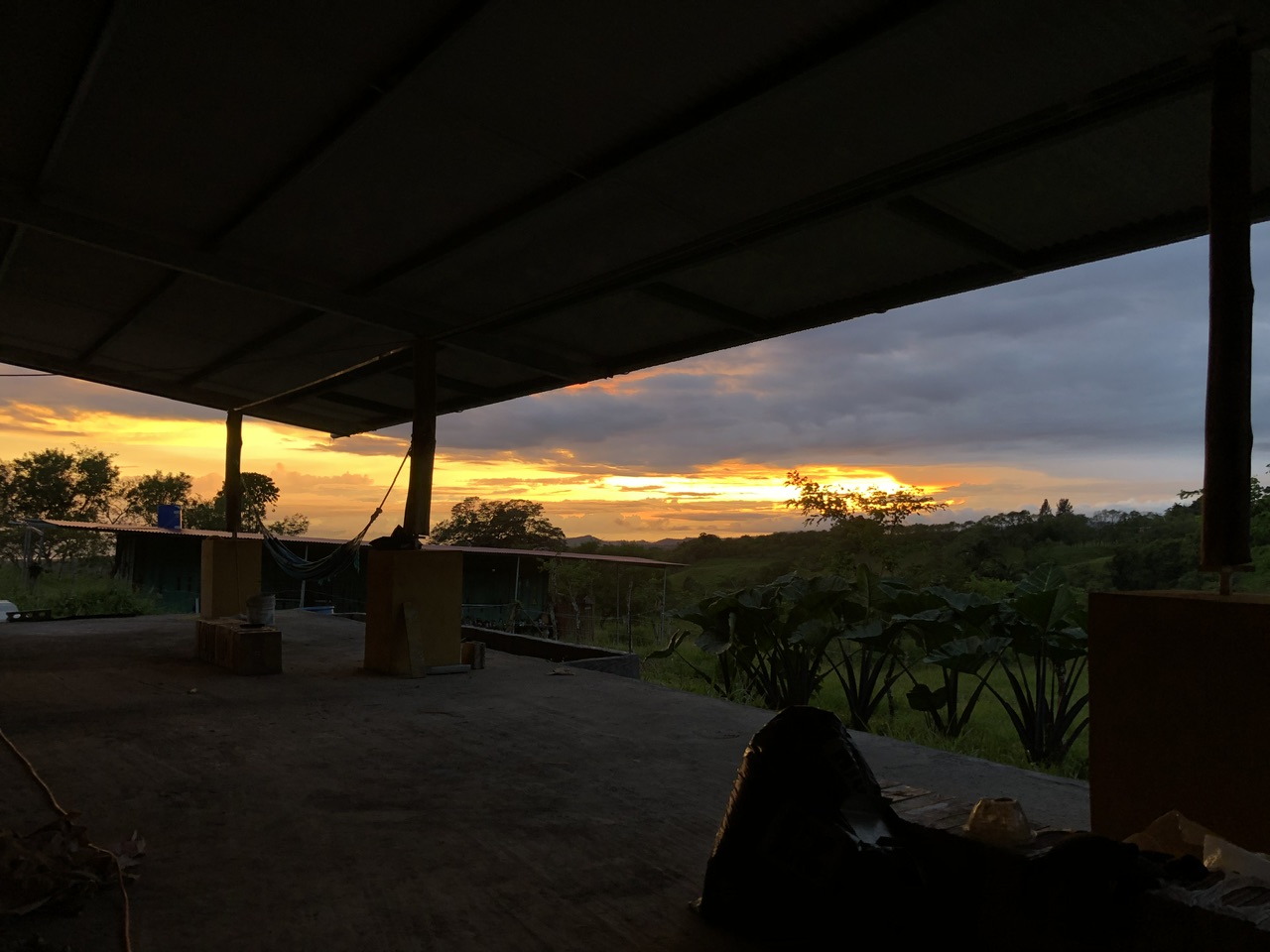
Even though it is not yet finished, I am about to put it on the market. I’m curious how it will be received by those who are coming to retire in Panama… For now, I enjoy my sunrises and sunsets on the big terrace overlooking the pastures with cows and the one or the other horse, and listening to the birds, the rushing of the water of the river bordering my land, and the sound of the rain on the roof when the afternoon showers arrive…
Two of the (to me) most amazing things of the nights here: the hundreds of lightning bugs in the surrounding fields create the flair of magic. And for the first time in over 40 years I am able to see the milky way again, due to the much lower light pollution around here, than where I used to live in the US and Europe.
Over the course of our lives we collect "stuff". Some of that stuff is easy to get rid of, there's no emotional connection. Other stuff is easy to leave behind, as it is easy to replace, if needed again. But some we want to retain...
In my case, I trimmed down as much as I could. But I still had a 3m by 3m (10 x 10 ft) storage unit full of items. Mostly, they were tools, books, DVDs and CDs, and memorabilia - a picture we had bought in India and which Suzanne had framed for me for my birthday, a wooden relief I bought when living in Tobago, photo albums, and similar items.
A week ago I came back to the USA to prepare these items to be shipped to Panama.
I contacted several moving companies in the US, but received quotations that were way beyond what I was able and willing to pay. The worst was 25,000$! When I looked in Panama, I found a customs broker who provided a reasonable quotation, and who was able and willing to answer all my questions. And questions I had many - I'm not doing this kind of thing every other week, so I'm not familiar with the process!
RS Aduanas offered to provide a 20ft container, have it delivered to the storage facility, where I could load it up, then transport it to Panama, arrange for the customs process, and have it transported on to my new home in far distant rural Panama (10 hr drive with passenger car from the port) - all for about 5,400$. What a difference!
Panama customs requires a detailed list of all the items that are being shipped. So I had to go through everything, open every box to see what's in it, and inventorize everything.
Originally, I thought I'd rent a second storage unit just for a week, into which to move items that I already added to the list. However, the storage company wanted to charge me a full month's rent. Their offer of 1$ for the first month had a * next to it, and the fine print allowed them to exclude just exactly the unit I needed! They wanted 200$!
During one of my sleepless nights the idea occurred to rent a Penske truck instead. (Penske, BTW, is a much better company to use than UHaul! Penske gives you a quote and you pay what they quote. UHaul always adds many other fees afterwards, and when paying you get hit with a much higher amount than originally quoted and expected. Penske you can trust! UHaul you can trust to charge you way more in the end!)
Turns out, renting a 16ft truck for 5 days was just 150$. In addition, loading everything into the truck had several other advantages:
First of all, I can back up the truck all the way to my unit, and loading is much easier than carrying everything across the storage facility to another unit. Secondly, loading the truck means I'm already lifting everything 1.2m onto the truck bed, so getting it into the container will be just 30cm (1 ft) more. And, the best part, I'm not tied to the storage facility anymore. That facility would make life of the trucker very difficult, to back into it and park the truck so the gate can safely close. If some other renter arrives, we might have to move the truck out again, and back in all over again...
Using the truck, I was able to redirect the truck to the motel where I was staying and move the load there.
Yeay! Everything in the truck - 4 hours, including making the list!
I was very concerned about how much effort it would be to take everything out of the unit and create the list. But, it took us only 4 hours to get that part accomplished!
My dear friend Cherryl had taken off the day from work to help me with this process. That woman worked like I would have expected a hired college hunk to work!!! Even the ultra heavy Bosch washing machine we were able to roll up the ramp into the truck using the dolly.
I had booked the motel for 4 days, expecting to need at least 2 or 3 days. But, we got it all done before I even checked in! Well, I had a few days where I could try to source a few other items I had on my list, which are not available in Panama.
So much crap!!!! 😖
In case you end up near Elkton MD one day and need a motel, I would like to put in a plug for the Sunrise Inn where I stayed. It is a lovely old motel, like out of a 60s movie. Nicely restored and operated by a family. I found the room to be clean and very spacious, the rate affordable, the mattress to be comfortable, and the nights to be nice and quiet...
So, yesterday the container came. This time we loaded it in 1 1/2 hours! Well, The driver was a very friendly and helpful man! We connected well, as he's originally from Haiti, Cherryl from Jamaica, and I used to live in Tobago... He, a true gentleman, didn't want Cherryl to deal with the heavy stuff and helped me with it.
Darn! There's so much space for more stuff!!! 😝
Well, we were done before noon, and the container went on its way! Yeay!
Off you go! Have a nice trip! See you in Chiriquí, your new home...
Now there's only my Prius left. I am planning on dropping that off on Friday at the Baltimore harbor for Roll-On-Roll-Off shipping.
Then I have no more physical ties to the US. Only emotional ones to the friends I made there... Next week on Tuesday, I'm flying back to my new home country. If Iris should get a visa, we might come back to the US to visit my friends. But I won't "have to" return anymore...
Whao! The second volume of my life, from age 30 to almost 60, is now about to be finished! The third volume, the autumn of my life in Panama, has started! I'm excited to see what experiences it will bring. So far it was very, very nice! And with Iris in my life, I think this third chapter will be amazingly wonderful...
You can not apply for a Panama driver's license as long as you don't have an at least temporary residency. But, as soon as you have it, your foreign driver's license is no longer valid!
So, in theory, you can drive yourself to the Immigration Services building to receive your residency, but you can not leave driving yourself...
So how do you get a Panama driver's license?
There are two options:
a) you get your foreign driver's license transcribed
b) you start from scratch applying for the Panama driver's license like a local teenager does
Why would you even consider starting from scratch?
Well, to transcribe your foreign license, you have to get it notarized by your consulate. Then you have to get a certified translation. And have it approved by the Panama Ministry for Foreign Affairs. After that, you simply go to the licensing office (SERTRACEN) and they give you your Panama Driver's License.
That works well for europeans (i heard from friends), probably for canadians as well. However, for US citizens this option is very unattractive (to use a kind word).
Why? The US State Department is totally for the birds! I only had to deal with them 3 times in my life, and every time they surprised me with how inefficient, incapable, and useless they are!!!
This is one of those three times.
As soon as I got my residency, I tried to get an appointment with the consulate to notarize my US license (Yes! You have to get an appointment! You can't just go there, as with other countries' consulates!), but they didn't have an appointment available for 2 (TWO!!!) months!
That means, for more than two months I would have to use buses and taxis, even though I have a car and am perfectly capable to use it. Secondly, I have to either spend a day and pay 300$ for airline tickets to travel from Chiriqui back to Panama City to visit the consultate, and fly back in the evening. Or I could spend 30$ for bus tickets plus 30$ for two nights in hotel and spend three days for the same task.
Makes no sense!
So how to go about getting a Panama Driver's License from scratch?
First, you need to go to a driving school and apply for a student's license certificate. That costs 60$ and takes about 15 days. But don't worry, you don't have to take any classes, or driving lessons! It's just a bureaucratic step.
While you're waiting, you can practice the theory test questions. There are two sites of interest:
Here's the link to the list of 133 questions in english, and here's the link to the page with the practice test. (Click on REALIZAR TEST to start the test). You can take the practice test as often as you like. Most of the answers are quite logical. Some are just something you have to learn by hard...
Once you have your certificate, you can make an appointment with SERTRACEN, and go there to take the tests. The driving school makes that appointment for you.
You have to take two tests:
The theoretical test is on a computer. You get 10 questions out of the 133 questions. You have to get at least 7 answers right.
Then there's a practical test - in David it is on a sectioned off part of the parking lot at Federal Mall (inside which SERTRACEN is now, since Chiriqui Mall burnt down). That test consists of three tasks: You have to parallel park, park perpendicular going in nose first, and park perpendicular going in backwards. You have about 2 minutes for each of the three tasks, and you have a lot of space. So, for anybody who's been driving for a little while already, these tasks should be fairly easy - no, VERY easy - to accomplish!
Note, for the practical test you need to bring a car, they don't have any rentals available. Secondly, you HAVE to be alone in the car, and nobody is allowed to be close to the parkinglot section where the test is taking place (taking a video or just watching). You gotta be totally on your own there...
Obviously, I chose the second option to get my Panama Driver's License. I was very worried about it: how difficult will the theory be? Will my Spanish be sufficient? What are they requiring for the practical test?
But, it turned out to be not a big deal at all. I took the test (and practiced the test) in Spanish, and it was quite doable even with my very limited Spanish skills...
Well, I just hope I will never need anything from the US state department! And I am very glad I do have my Panama residency and Panama driver's license. Yeay! Step by step the bureaucratic hurdles are taken...
I read a newspaper article today in the Salzburger Nachrichten, reporting on an exhibition of photographs with old folks, who have been sent to nursing homes and are basically just waiting there for the end of their life.
It made me very thoughtful!
Ausgemustert - Out of Service!
I'm heading there, too. Or am I there already? I retired. I stopped working for money. I am no longer pursuing my career as software engineer. am no longer in service the way I used to be!
There are quite a few older expats in the area where I moved to. All but one, actually, are retired.
But, we're by no means "just waiting to die"!
View of Pacific from 700m above sea-level - the road passing my home leading to town
The one expat neighbor who's still in her 40s had moved her mom here during the pandemia. The reason was exactly this: her mom was shutting down more and more. From each video call to the next she noticed the decline of her mother. Until it was more than she could take and she picked her up from the nursing-home in the US and brought her to live with her here in Panama. In the two years her mom is now living here her decline not just stopped, but turned around! She is now full of life again, enjoying walking in the large park like garden, singing karaoki, delighting in the food - much of it fresh from the garden. What a difference!
For the retirees of us it's about the same: we are all enjoying our time here on this planet. Panama makes it possible - no matter what condition we're in! While we're still agile enough we can work our own garden, explore the beautiful country, delight in reconnecting with nature. If the garden is too big, or cooking is not our thing, or there's anything else that needs to be done and we're not up to it for whatever reason, there are many people around here, who love to take care of these tasks for us. And it does not brake the bank!
Instead of paying 7,000$ a month for assisted living, here you can hire a live-in caretaker for 1,000$, should you need one.
Instead of being fully dependent on the grocery store half of the year, here your garden bears fruits and vegetables and roots all year round. You decide how organic you want your food to be.
Otoe - a root vegetable like yucca - also just 7 months old
My neighbor and gardener Carlos planted these banana trees about 7 months ago
Instead of feeling out-of-service in the sense of "cast aside", "locked away", here you can feel out-of-service in the sense of no longer having to work.
Instead of feeling abandoned and lonely and disconnected, here you can reconnect with nature, be taken care of as much or as little as you want or need, and - if you treat your neighbors and caretakers nicely - be integrated again in a village life!
Even more! You can be the window to the world for the neighbors' kids. Through you, they - and their family - get a chance to get to know about another culture, get introduced to different ideas and approaches, and get inspired to learn, grow, and be open for the world!
What a difference!
There the rest of your life is just wasting away. Here, you are making a difference to your last breath!
There you are a problem. Here you are appreciated and part of a solution!
My neighbor's son loves to hang out with us. Soon he'll start learning english in school. He'll get plenty of opportunity to practice with us!
If you want more information about various topics, here are links to my blog posts about: residency options, learning spanish, the climate, locally grown food. For any other questions, you can ask in a comment, and I'll try to answer or point you to where you can find more information.
Financially, here's the summary: if you're retired you need a pension of 1,000$ (1,250 for you and your partner). If you're not yet retired, you can invest 130,000$ in a reforestation project for your residency. If you want to buy a comfortable real estate, you can get something very nice for 150,000$. Or you can rent something nice for under 1000$/month. So, financially it is very feasible for almost anybody in Europe, the US, or Canada, Australia, and such...
If you want to come for a visit to see how it suits you, chat me up, I'll help you plan and arrange if you like... For me, now was the time to be adventurous, but in a safe way. How about you?
There are two types of houses that are available in Panama, based on what I found when searching:
Homes built for locals, and homes built for foreigners.
The homes built for locals are quite affordable - but there's a reason for that: the quality standards and designs are not really up to what a typical foreigner would find acceptable.
Today I encountered one of the very typical problems also in Iris' house: the toilet drains tend to get clogged. I can't count how many local toilets I visited where signs of "Don't throw toilet paper into the toilet" are tell-tales of this issue!
I had installed a toilet a while ago - a provisorium. We didn't have running water yet, but we simply refilled the toilet-tank from a bucket after flushing. No problem...
The toiled drain in the other bathroom was plugged with some crumpled up cement bag - originally, so no debris falls into the pipe and causes problems later on. Lately, also to avoid gases from the septic system to come up through open hole.
Well, after tiling the whole bathroom, and grouting most of it, as well, I got ready to install the toilet here, too. Trying to remove the paper was very hard. It seemed to be soaked, and had lost any cohesion! Once I finally got the paper removed, to my great surprise, I found a "soup" sitting in the toilet-drain. (Explains the moist paper plug! Yuck! 😝)
Soup sitting in drain is an unpleasant surprise in many ways
Apparently, the self-proclaimed "specialist" had glued the pipes together with a inclination instead of a declination! So, part of what was flushed down on the one bathroom, ended up flowing down the pipe to the other bathroom!
I have encountered many problems already in this house, and fixed them, or found a work around. But, how the heck, am I supposed to fix this one?!?!
I decided to break the finished tile-floor again, and using the jackhammer, open the concrete floor, and see if maybe the pipe can be lifted a little bit.
Well, obviously, that didn't work out! A 1cm (1/2") pipe is a little flexible. But a 10cm (4") pipe doesn't move a mm on such a short length!
3 hours of work to dig out that pipe again
It looks, as if the pipe is forking off the pipe of the other bathroom, using a Y piece. And, 30cm after the Y and 60 cm before the end where the toilet is going to be sitting, the foundation of the wall between the bathrooms is fixating that pipe. It is in the wrong position for good! Cast in concrete, literally!
So far I have not been able to come up with any idea as to how to fix this problem! The only thing that might make life easier with a constantly clogging toilet, is a cleanout access close to the toilet. So, when the pipe is clogged, it is possible to insert a pressure hose without having to uninstall the toilet each time... So, if no better idea comes to me, I'll be cutting the pipe and inserting a 5cm (2") fork and letting that 5cm pipe lead all the way to the bathroom floor and put a plug on that. Not pretty. But kind of hidden a little by the toilet bowl, so you don't immediately see it, when entering the room.
How the heck to fix that!?!
Well, we're about to go on another vacation to Austria. The hole will stay there until we get back, and whatever the best idea is going to be by that time, I'll implement...
Now, just to be clear: The issue of incorrect declination of the sewer pipes is a problem as well of many homes that were built for foreigners! One more reason for me to be present all the time and to double check everything while I am having my house built!
I made two mistakes around my pet during the last year. The same mistake, twice, to be correct. The first time, I guess, the shocker wasn't enough for me to learn my lesson. So this time I got a real big one!
But, let me start at the beginning...
Last February, while visiting my family in Austria and before really emigrating to Panama, I mentioned to my sister, that now I might be able to finally have a dog myself, too. I have been travelling a lot throughout my worklife. This kind of life doesn't suit having pets. It would be rather unfair towards them...
My sister just laughed and told me: Just wait! A dog will find you and adopt you soon!
And so it was.
When I arrived back in Panama, my friend Kyle, with whom I was staying most of the time when in Panama, lamented about a dog who had shown up about 2 weeks before I arrived. And she wouldn't let him chase her away! He didn't feed her anything, even shot with his slingshot metal balls at her! To no avail! She would just keep on coming back.
While he was telling me this story, there she comes running down the driveway, onto the terrace where we were sitting. She totally ignored Kyle and came straight to me, putting her chin on my knee, looking at me with those beautiful brown eyes, as if she was saying "What took you so long? I've been waiting for you!"
And so it was, that I was adopted!
Weibi - happy to finally get some food and love
In order to stop myself calling her "Kerlchen" (which is Austrian for little fellow, I decided to name her "Weibi" - which is Austrian for "little woman".
With her I made the first mistake.
I was so busy looking for land, purchasing it, dealing with the legalities, and then later helping Iris with the construction of her house, that I never found the time to take her to the vet. I had no clue whether she was sterilized or vaccinated. I just embraced her in my life, without taking care of her needs!
Well, that was in April. By October she became very "fat". And on 15th of December last year she gave birth to 7 puppies.
We had just come to Camarón Arriba, Chiriqui, and were living in the container, which I had purchased a few months before and remodeled into a workshop/storage space and a little living area, with mattress and fridge. That morning, around 4 am I woke up from her making a strange chewing noise.
Turns out, she had delivered one puppy and was trying to bite open the placenta-bag. She wasn't successful fast enough, and we didn't notice early enough, so the puppy died. But, when the next puppies came, we were alert, and Iris knew what to do. As soon as the puppy came, she opened the bag around the mouth of the puppy, so it could breath.
Two of the ultimately five already there
Over the whole morning, one puppy after the other was born. The 6th around mid-day. Since there was nothing happening anymore for hours, we thought she was done birthing. But, by 16:00 (4 pm), the 7th puppy came - again unnoticed by us. Again, the bag wasn't removed quickly enough, and it died.
So, here I was, having to take care of a mother with 5 babies!
Tiny furballs - eyes closed only sleeping and nursing
about 2 weeks old - eyes still closed
What to do with them? Who could I entrust any of them? The locals don't treat dogs the way we in Europe consider to be well. And the foreigners I knew all already had a dog! Aye aye aye!
nothing but a handful of cuteness
Nursing is very exhausting, it appears
Growing up soooo quickly!
Just like human babies - no care in the world!
Trusting that everything will be taken care of for them
She must be thinking: What did I get myself into with that! How did that happen?
I read up on puppies, and promised myself to take them all to the vet as soon as they are ready for it. And I did for the first visit. Weibi was sterilized, and the young ones dewormed and whatever else is done on the first visit. But it was still too early for them to get vaccinated.
By the time vaccinations were possible, we were back in Santa Catalina, Veraguas. To reach the vet, it takes 2.5 hours of driving each direction. The dogs - both the mother, as well as the babies - get car sick and throw up. It's a torture for them. And a lot of work for us to clean up the car afterwards. Also, I had "guest-workers" from Chiriquí here, who wanted to maximize their income and worked from 6:30 (am) to sometimes 19:00 (7:00 pm) or even later! Every day, except Sundays. I needed to be there, so they knew what to do, and to answer questions and make decisions when they arise.
And I postponed the vet. And I postponed. And postponed, and postponed.
Then we went back to Chiriquí. The dry season has almost ended, and I didn't want to wait another year to get the slap for my house done. During the rest of the year it starts raining almost every day by 13:00 or 14:00 (1 resp. 2 pm) in the afternoon. A slab needs to be cast in one sitting - so this is only possible during the dry season.
Well, last week, I got my second lesson about the same topic...
Thursday evening, I noticed Patas Blancas to be kind of low key. Friday, he didn't eat much, but was just laying around looking miserable. Saturday, realizing that Monday is a holiday, I decided to face the 2 1/2 hours of driving in the heat, with dogs puking everywhere in the car (they didn't want to stay in the back, where I had placed a sheet of cardboard) and take them all to the vet: checking out Patas Blancas, and vaccinating (finally!) all the other ones.
When Iris asked me to come inside to hear what the vet has to say, I thought, that doesn't sound good.
And, yes, it wasn't good at all! The symptoms of Pata Blancas pointed strongly at Canine Distemper , about the most terrible disease for dogs. Highly infectious, and in 99% of the cases deadly.
There was no sense in trying to vaccinate any of them at this point. We got some medicines - for Patas something to ease the pain and discomfort. And for the others immune strengtheners and other stuff. Iris is very good with that - I am terrible. I don't want to take pills myself, and have a hard time managing 4 medications for 4 dogs 3 or 4 times a day. But, Iris handled that situation very well! So glad she is in my life! She complements me so well, filling in where I am weak, and supporting me even more where I'm strong!
Patas got fluids and some IV medications. When we drove home, he appeared a little better, and we got a little hope. But, that dissipated quickly, when we tried to give him some food he had absolutely bo interest in it. He tried to drink some water, but through it all up again 5 minutes later. It was terrible to watch!
And I couldn't get the picture out of my head, when we were in Chiriquí just 2 weeks earlier, and the three little ones followed Weibi roaming the fields, barking at some of the cows and horses, and just frolicking around. As they were walking through the high grass, the little ones were jumping rather than walking to be able to get ahead. all of them happy, full of life and energy!
I felt really terrible having wasted their life so carelessly by not making it a priority to go to the vet. It's too late now. There's nothing more that could be done...
Iris sat up with Patas until the early morning, when he finally fell asleep and never woke up again!
Panama is a central american country. As such it is not a rich country. And, they are still behind in many areas, compared to Europe, Canada, US and such. At the same time they are ahead of the US in several aspects as well!
I spent a lot of time in Panama City over the last two months. I observed many signs of improvements and many attempts to facilitate improvements in areas where it is urgently needed.
That's one of the big difference with the US. In the US there are no movements in any of the important topics: guns, two-party-system deadlock, public transportation, healthcare for all, schools, quality of education across the board, the (bad!) joke of a legal system, and so much more...
But, let me talk about Panama. Much more interesting! And much more to report about, too!
Here are a few pictures of bill-boards I noticed across the city and country:
These bill boards show, that the government is trying very hard to move the country forward in a good direction. Yes, the majority of the population isn't there yet, and doesn't care much about any of these topics - many are still struggling to put food on their table. But, as Panama is putting a lot of effort into educating their young, the change is going to be happening soon, I would say...
Panama has built schools in every little village! A governmental school - so it is affordable and accessible to everybody. Yes, not all schools have the best teachers - yet! But, that is changing already, as more and more kids are finishing university.
Panama also has general public health care system that everybody has access to. Imagine this! Panama has figured out a way to do this, while the oh so great US seems to be incapable of it! Oh, and the doctors in the public hospitals are quite well educated and capable! The hospitals may not look all too great, but the quality of care is impeccable! And VERY affordable, too, I may add!