Showing posts with label retirement projects. Show all posts

Tuesday, December 31, 2024

Trump - beloved the world around…

There’s a custom for new year’s celebrations in Panama to build a puppet and burn it around midnight on 31st of December.

Well, the people in Panama didn’t appreciate Trump’s last brainless comment in a string of such, where he mused about taking control of the Panama Canal. I happen to drive by a pair of such puppets today, ready to be burnt…


On first sight maybe amusing. But knowing how Panamanians feel about the canal, this is a clear signal to Trump about what would expect him should he be stupid enough (which he often proved to be) to try to follow through with this idea: All the people of Panama resisting! 

Panama has no military. But he would have to fight all the civilians! Men, women, and children! Would his military comply with his orders? Would turn them into war criminals right away… If they would, how would the Europeans react? How would Russia react to a break in Nato? How would the Chinese react? 

Many questions, which nobody at this time can answer for sure. But I hope we never have to find out in reality…

Sounds a bit sarcastic, but still: happy new year! Happy new quarter century!  


Thursday, March 14, 2024

Real Retirement

I’m working on two houses - mine in Camarón Arriba, Chiriquí, and Iris’ hostal in Santa Catalina. And I’m working in the evening in the restaurant, trying to help out Iris, who’s baking the best pizzas I’ve ever seen and eaten - she can’t bake pizzas in the kitchen and take orders on the dining terrace at the same time; although this is pretty much what she did before i came into her life… Well, each one of these three jobs by themselves would be sufficient to make you forget that you’re retired! I’m doing all three of them! My sister once joked: “if thisis what retirement’s supposed to be, i’d rather stay in myjob!”😝

But, It not complaining! Iris is working on the same three jobs, just more hours per day than me! And she’s running the household, cooking, cleaning, and all of that in addition! The only explanation I have how she’s able to do all that, is, that she’s the Duracell (Energizer) Bunnyincarnated! 🤪😇

Well, today, I took time off from all my work to try to bake another cake. I followed “Baken mit Christina”’s recipe for the Mandel Blume (Almond Flower).


It’s hard to get some of the ingredients here that are common and usual in Austria, but following the Panamanian way I improvised where needed. The result is quite tasty, if I may say so myself. my ex-wife usually wasn’t all to excited (to say the least) when I cooked or baked. Iris, however, loves my cakes! 🥰😇🙃 She has been bugging me for a little while already to bake a cake again. Today was the day… 😝

Monday, January 8, 2024

Gotchas of Panamanian buildings - worst practices

In every industry, over time, best practices are developed and defined. The builders in Panama, however, seems to not have adopted much of what’s common practice in other countries. Well, there are two types of builders: the large construction firms that build skyscrapers, and the little guys who build homes by hand.

I have no idea about the large construction firms, I’m taking about the little guys. 

Many of the little farmers can not survive off their farm and are subsidizing their income by working in construction. Everybody out in the country seems to know how to work with concrete. Many know how to weld, or do plumbing, or electrical installations.
They have learned by watching and assisting somebody else, and then just doing it often. They never got proper training, or schooling about the theory.  They do as well as they know how!

At the same time, most people here don’t have a large enough income to be able to afford hiring a firm to build their homes. Instead, they save up a little money and buy some sand and rocks and a couple of blocks and bags of cement, and build as far as their material reaches. Then they wait until they have more money, to do the next.

As a consequence, work is performed in a way that is the least costly, and the easiest to perform.

My personal most feared “worst practices” are these:

Anywhere you go in the country you’ll find a trashcan next to the toilet bowl into which you’re supposed to place the used toiletpaper. you should not throw the paper into the toilet, as you’re used to do in europe, the US or similar countries. the reason for this is, that the drain pipes are sometimes too small and most of the times don’t have the correct declination. if that pipe is too steep (more than 3cm per m, 1” per 3 ft) or too shallow (less than 2cm per m, 3/4” per 3ft), the solids tend to get stuck. With paper it clogs the pipe frequently. Worst practice: drain pipes incorrect declination.
Declination of drain pipes does often not follow best practices, but rather the terrain


In my house I put extra care and effort to ensure the pipes have the right declination. So toiletpaper can be flushed down without problems! 
Also, I ensured that for every pipe there’s easy access for a snake tool,in case the pipe does get clogged for any reason at any time.

Electrical wires are color coded. White is neutral, bare or green is ground, and black (red, blue, or yellow) are phases. In local homes (and businesses as well) you often find cables used not according to their color. That makes troubleshooting very difficult and dangerous!

In this box, the leaving cable uses white for hot and red for neutral!

In my house I took great care that wires are used with the correct color coding. 
Also, I made sure in every junction-box and the breaker-box every wire is labeled with the circuit it belongs to. Again, to make maintenance and troubleshooting easier, should there ever be a problem, or the need to extend the system.


The floor in walk-in showers are supposed to decline towards the drain. Often it doesn’t, so there’s always a puddle on the floor. Over time that part of the floor gets grimy and slippery. 

In my house I had the mason adjust the subflooring multiple times, until there was the right declination in the whole bathroom! Also, I selected tiles that don’t get slippery when wet. That way slip-and-fall accidents are less likely.

There are more issues I noticed. I might add some more at another time… For now, these are the most annoying, and the easiest avoidable issues…

Sunday, January 7, 2024

Gotchas of Panamanian buildings - architecture and the basics

 New acquaintances happen to start building their home here in Panama, actually, not too far from my house. I started telling them about various aspects about the local architecture and building practices. then I realized, it might be interesting and helpful to others as well. so I decided to blog about the gotchas I encountered…

Here you go! The first installment. More to come…

The local architecture has two styles: the local style and the foreigners style. Both are, in my view, flawed, as they don’t take the climate and environmental problems into account.

First, the style for foreigners:

On first sight, the homes built for foreigners are lovely! But, after careful examination, the beauty turns out to be just skin-deep! 

typical house for foreigners - US architecture, solving problems they have there, but ignoring problems and benefits we have here

Essentially, the architecture is just copied from the US. There are specific problems that are addressed by the designs. However, these problems don’t exist here! In the US you need your home to protect you from very low temperatures in the winter and very high temperatures in the summer. Also, tornadoes are possible in almost the whole country. 

Here in Panama, the temperatures are always the same, and it rarely reaches the 90’s C (upper 30’s F). So you don’t need protection from the temperatures! Also, except in some special places, wind is not a problem. There are no tornados, here, nor hurricanes!

Here, you can be outside all the time, except for sleeping. So, with a house where all livingspace is indoors, isolated from the rest of the world, you’re missing out on the best part of living in Panama - living outside!

What’s worse, though, is, that this architecture does not offer a solution for the environmental problems typical for here: lots of sun and rain, and always super high humidity of the air, unreliable electricity and water supply. To fix the lack of consideration of these topics in the design, super large air-conditioning and dehumidifying systems are installed. In addition of being locked away from the fresh air, you’re subjected to constant noise, and high electricity bills! 

I’m trying a different architecture, that takes the local problems into consideration, and maximizes the benefits of living in a tropical location. (More on that later…)

But before that, the local style:

They dig some ditches where the walls are going to be to create a foundation for them. The sewer pipes are laid. And the walls put on top of the foundation. On top of the walls cariolas are being placed and welded onto the rebars sticking out of the concrete. The sheet metal roof is screwed onto these cariolas.

First problem: the foundation. Much of the land is covered with fertile, black soil. that soil doesn’t carry load well, easily shifts due to much water during the rainy season and lack of water during the dry season, and from the relatively frequent, although weak, earthquakes.

As a result, many buildings have cracks in the walls, or are starting to hang a little over time.

My attempt to address the problem is to use a bed of cracked stones, similar to the beds of railroad tracks. On top of that, I poured a 20 cm thick concrete slab, onto which I built the walls and placed the posts that carry the roof.  First of all, water easily finds its way through this bed of rocks, secondly I placed drainage pipes all around to ensure there’s never much water getting there in the first place. But, should anything underneath there shift a little, the rocks distribute the load and cover for the uneven load-bearing quality of the ground underneath.

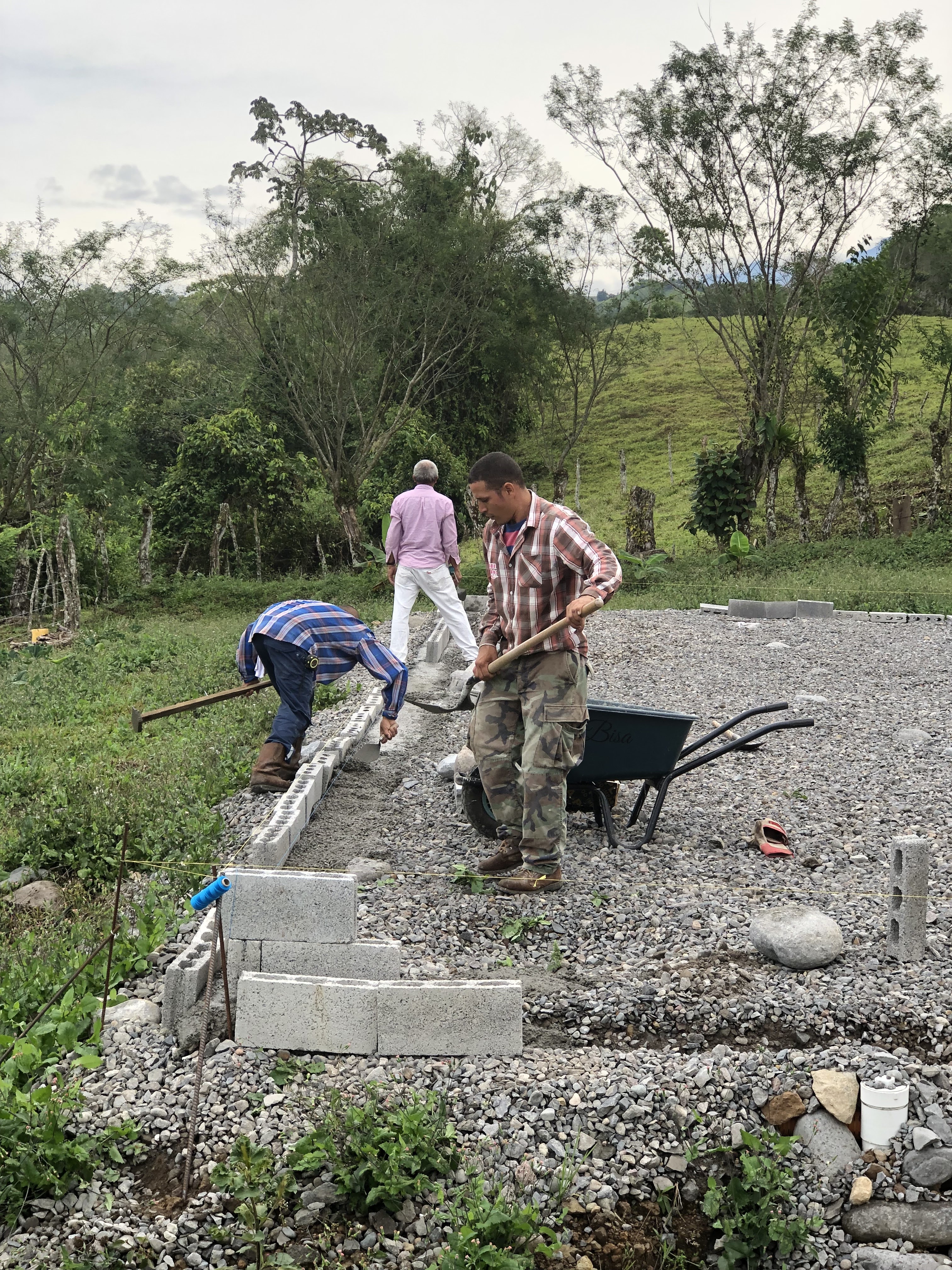
Using 10 cm wide blocks to build a form for the concrete slab on top of 20 cm crushed stones

laying the rebar mesh and placing the cariola frames for the doors so everything is nicely connected with the slab

pouring the concrete slab - Iris working like the men!

Walls on top of the slab. Two rooms with a bathroom each and the connecting wall that separates the kitchen from the back terrace. On the left, forms for poured concrete corner columns are visible

Welding together the cariola structure that will hold the sheetmetal to form the roof

The basic structure is done! The roof is also almost finished, it protects the rooms and the big terrace that is the living room, dining room and kitchen. Living in and with nature, not isolated and separated from it!


Next problem: the walls. The walls are build with 10cm thick concrete blocks, which have three holes to be filled with concrete once the block is in position. Aside of some of the workers not using “plomos” to make sure the wall is really vertical, most use their “palaustre” (heart shaped trowel) to push the concrete down in the holes and compact it. These tools, however, are too wide to go all the way to the bottom of the block. As a result, usually the blocks have concrete on top, but a hollow space filled with air in the bottom. 

typical block wall, space for columns on side of doors nicely visible. Hole in block to be filled with concrete visible well, too.


The building code requires all corners and the sides of all windows and doors to be solid concrete columns, build through forms, not blocks, and with rebars enforced. And on top of the windows and doors, and the top 30 cm of all walls are supposed to be solid concrete beams, too - also built with forms and rebar enforced. Those parts should take the load, so even though the walls are mostly air, the house should not crumble. But, “should” isn’t good enough for me! I want to be sure. So i asked - and fought during the whole wall building process - that the helpers use rebar sticks to ensure the holes in the blocks are filled with compacted concrete all the way to the bottom.

Third problem: the heat and humidity. The roof gets very hot from the sun.VERY hot! T
here is no space between roof and wall, so all that heat is absorbed by the concrete. Even as the temperatures fall during the night, it is always hot in these houses! The sun heats up the house during the day, the concrete keeps it hot during the night! The lack of decently sized windows and the fact that the local style sliding windows only open half, doesn’t really help the situation.

Also, due to the super high humidity all the time, when there’s standing air, there’s very quickly mold and mildew. All the mold-resistant paint in the world is not a working solution. Keeping fans running in every room for 24 hours a day helps, but uses a lot of energy!

My attempt to tackle the problem with the humidity is by having many big windows, which can be opened all the way. That way, there’s always a breeze in the room - even without fan. No mold, nor mildew! And feels cooler, too!

To reduce the heat in the house, I have a pretty large crawlspace between the sheet metal roof and the wooden ceiling of the rooms. There’s no wall above the rooms, so air can circulate and move freely. Middle school physics says, hot air rises.. Alright, the air that gets heated up under the sheetmetal can freely leave that space, and cooler air can move in. that crawlspace never gets really hot! And, wood being a good insulator, the wooden ceiling - even though only 2cm (3/4”) thick, ensures that the room, nor the walls that makeup the room, never get really hot.


note the space between the ceiling of the rooms and the roof, and the big windows 

I got the confirmation that this works already while building: several of the workers mentioned on various occasions that it so nice to work in the house because it is  not so hot, as in their homes…


The best part about living in this tropical place is, that you can be outside all day. There’s nothing nicer than hearing the birds, the wind in the trees, the rain gushing down, to feel the breeze, to always breath fresh air!

The architecture I think is ideal for here is a home that most of all has a big terrace under a roof. The roof keeps you dry when it’s raining, and its shade protects you from the sun. There are bedrooms and bathrooms that are wrapped in walls, but they, too, are well connected with the outside through doors and  large windows that are protected by insect-netting and can be left open almost all the time.


large terrace serves as living room, dining room, and kitchen

rain water is collected and provides the water for showers, toilets, and kitchen as well (filtered for drinking purposes). Stored in a higher altitude tank water supply works even during power-outages

Large windows in the bedrooms ensure the air in the room is always moving, reducing if not eliminating problems with mold and mildew


This house needs no air-conditioning, no dehumidifier, is independent of the public watersupply, and reduces the negative impact of the frequent power outages. By adding PV panels and a larger battery, the house can be completely independent from the public power-supply as well. 

You basically live in your garden - paradisical!


Update: just saw an advertisement for a house, which is built in typical architecture:

Typical house for local middle-class. Interestingly, the add is in english, implying they are trying to address foreigners, too…


Look at how small the windows are, and remember, this type doesn’t open all the way; only one half slides in front of the other one. There’s no air circulation at all in this house! Can you imagine how hot that house gets when there’s a power outage! It’s a baking-oven!

Friday, November 24, 2023

Finding excuse to not have to work…

 As I’m getting older I seem to have less and less energy. I already felt the onset when I was trying to renovate the house in Wilmington all by myself, in an attempt to proof to my then wife how much I cared about her. Well, she didn’t get the message… And i blew, it seems, my last reserve of energy…

Today, I’m working on building two houses here in Panama. And it’s getting harder and harder to get going every morning… 

The house in Chiriquí is about 4 to 5 weeks of work (with hired workers) away from being able to be put on the market. I’m hoping some nice folks to have as neighbors will find it, and enjoy the very unique architecture features and serene country setting, up high enough to have warm (not hot) days and cool nights. Despite the materials and labor costs having risen quite a bit over the last year and a half, I’m still thinking of being able to sell it for 150K - much less than the usual homes suitable for foreigners.

Backside of the house, as seen from the street

Huge terrace - the living room, dining room, and kitchen all at once

Guapo, my trusted worker. Front view of the house

Well, first I need to get it finished, though. And for that I need to get back to Chiriquí…


Currently, we’re in Santa Catalina, Veraguas. one of the best surf spots in Panama. Iris‘ house is really close to being able to make use of it. Really close, but not yet quite there…


Iris - family outing with dogs at playa estero

skin and bones! no matter how much I eat

Happy to take few hours off

Due to the countrywide protests it’s even more difficult to get materials and workers, as movement is very restricted. So I’m forced to try to work on my own…

I’m supposed to tile the livingroom/kitchen, sonIris can do the grouting. And I’m trying to build out one room upstairs, so we have a lockable space to store tools, materials, and other household stuff.


This morning, though, i woke up with the desire to bake Vanille Kipferl - one of the many traditional Austrian Christmas cookies. Iris encouraged me, too, to bake. She always seems to know what i really would like tondo, and asks me to do that. So, today, i baked these cookies, that used to be my longtime favorite sweets around christmas.

We bought a new stove last year. A mid-level style, I guess, as it was not cheap and also not one of the expensive ones. However, it doesn’t have convection fan. Nor does it have upper heat, but only from the bottom. the dial gives temperature ranges, just to make it even more challenging! 

However, given this stove and the fact i haven’t baked Vanille Kipferl in probably decades, they turned out  bastante bien (quite well). 

Proof of that is the fact that for desert at lunch we devoured already 1/2 of what I made!

what a delicious excuse to not have to tile… 😇😝🤪

Vanille Kipferl


Sunday, October 1, 2023

Reminiscing


I was always blessed with new ideas. Usually years before the “world was ready” for them. This is a blessing and a curse. The blessing, obviously, is that such ideas are exciting and fun to ponder. But, pondering alone never seemed sufficient for me, I always wanted to implement them, too!

I (choose to) believe, that “sending ideas” is one of the three ways the greater universe (or whatever you want to call whatever is outside of the physical system we live in - our universe) is influencing this system (our universe). I find it hard to believe that ideas just come from the neurons flying around my little, limited capacity brain… (Coincidences, and the fact that every person seems to have a passion, a topic that is very dear to their heart, are the other two outside influence I was able to observe (more on spiritual ideas, fulfilling live's purpose, and finding happiness here: toolOfTheUniverse.org).

The world seems to be functioning quite well as it is. But, then, there’s an idea that somebody receives. A foreign item. Something that wasn’t there as of yet. The system was operating without it. But now, as this person gets this idea, it is possible that it becomes part of this system. And the course of our world is forever changed. No matter in what little way… 


On the terrace of the home I’m building in Chiriquí the mason trying to lay tiles had the first tile slanted just a little - maybe 1 mm. Trying to keep all the other tiles level with this one, by the time his line reached the other end of the area 4m down the line, he ended up needing 4 cm of padding! Any little thing now can - and most often does - have a big impact later on! 


Ok, back to my ideas…

The wonderful thing about receiving ideas is that it’s exciting. The downside of it is, that if an idea is a bit farther out than the general population can appreciate, it’s hard to find somebody else who would partner in implementing this 


For example:

In the later part of the 80s I had the realization, that most of a relational database application - which most business application are still today - is made up of the same kind of program. The only difference in the various programs of any single type are the name of the table and the names and numbers of fields. There is also most often more or less of business logic for each of the tables, which differs a lot from one table to the other - but that is a comparably small portion.

So 35 years ago I implemented a first program generator. A program that writes the 4, 5 different types of programs needed for every table. It also linked the programs according to the relationships of the tables, created menus, and provided the hooks for business-logic, printing, and so forth.

That generator was the reason why Progress Software hired me in 93 - finally realizing my dream to move to the USA! Unfortunately, the new CTO, who started between my being hired and my actually starting with them, didn’t appreciate the idea - as was so often the case in my life… The project was cancelled, and I ended up working on something else…

BTW, Object Oriented Programming seems to be another approach to deal with the same problem: repetitive code. My experience is, though, that changing from procedural to object oriented approach did not make writing and maintaining programs easier at all. I’ve come to the conclusion, if you really want to create a mess, use object oriented programing! Without being very consistent in your naming of things and structuring your classes, a system becomes exponentially harder to maintain the bigger it gets. Larger system are virtually unmaintainable! At least those I encountered were so…

In the early 2010s I used the same approach as earlier on in my life to create a browser based application. I consider this application “my Mona Lisa”. After years of changing - not just the programs and DB structure, but even the whole focus of the application! - the system is still neat and consistent and super easy to maintain and expand! This application proves it is possible, it proves it is much less costly to build, and it proves to solve the typical problems systems are plagued with: hard to maintain, hard to extend, hard to adjust, hard for somebody new to understand and get into, high bug rate in code from get go and even higher once modified.

How is that possible? Estimated 80% of the code is generated and can easily be regenerated when there are DB structure changes. These programs are basically self-maintaining. The customized, manually written code is super-consistently following the same naming conventions and style as the generated code. That makes it very easy to understand, which in turn makes it easy to modify and extend.

I implemented this approach for procedural OpenEdge code. But, it can be used for any other language and many other styles of programming as well.

Personally, I don’t think we are able to deal with the complexities of the ever growing systems without the help of computers… computer programmed code is super consistent. Consistency makes life easier for not just people, but for computers as well…


Today, as I am retired from programming, I am working in a totally different area. But, I am, again, trying to implement ideas, new approaches.


I observed the architecture of homes in Panama. And it quickly became clear, there’s plenty of room for improvements!

The focus of local, Panamanian architecture is “cheap”. While it is fulfilling certain criteria well, there are tons of compromises about functionality and comfort. Too many for my liking!

For the foreigners, the architecture of northern areas is simply copied. There are problems in the north that simply don’t exist here - extreme temperatures is just the biggest of them. And there are problem here, that simply don’t exist in the north - super high humidity, just to name one of the biggies. Northern architecture provides solutions for northern problems. But not just NOT provide solutions for tropical problems, but even causes problems in tropical areas.

Using all the ideas and approaches I have encountered over the course of my life, adding my observations and experience living in a tropical climate, and - yet again, as usual - receiving many ideas, I am trying to create a home in Chiriquí that is comfortable and functional, affordable, makes use of and benefits from the local resources and climate, and deals with the local problems.

As if that is not exciting enough, it all is happening in a new, different language, and in an unfamiliar, different culture!

Despite being very busy and occupied by that big task, I’m trying to find the time to blog a little about it.
idea. 


My first house is taking shape already. So far, many of the ideas and approaches used are validated already! The topics of heat, humidity, type of foundation are just the biggest items on the list that are taken care of. Not by trying to fix the symptoms of the problems with the architecture by simply adding a/c, dehumidifier, and patching cracks in walls and floors. But, by having the appropriate basic architecture to deal with these problems from the get-go!

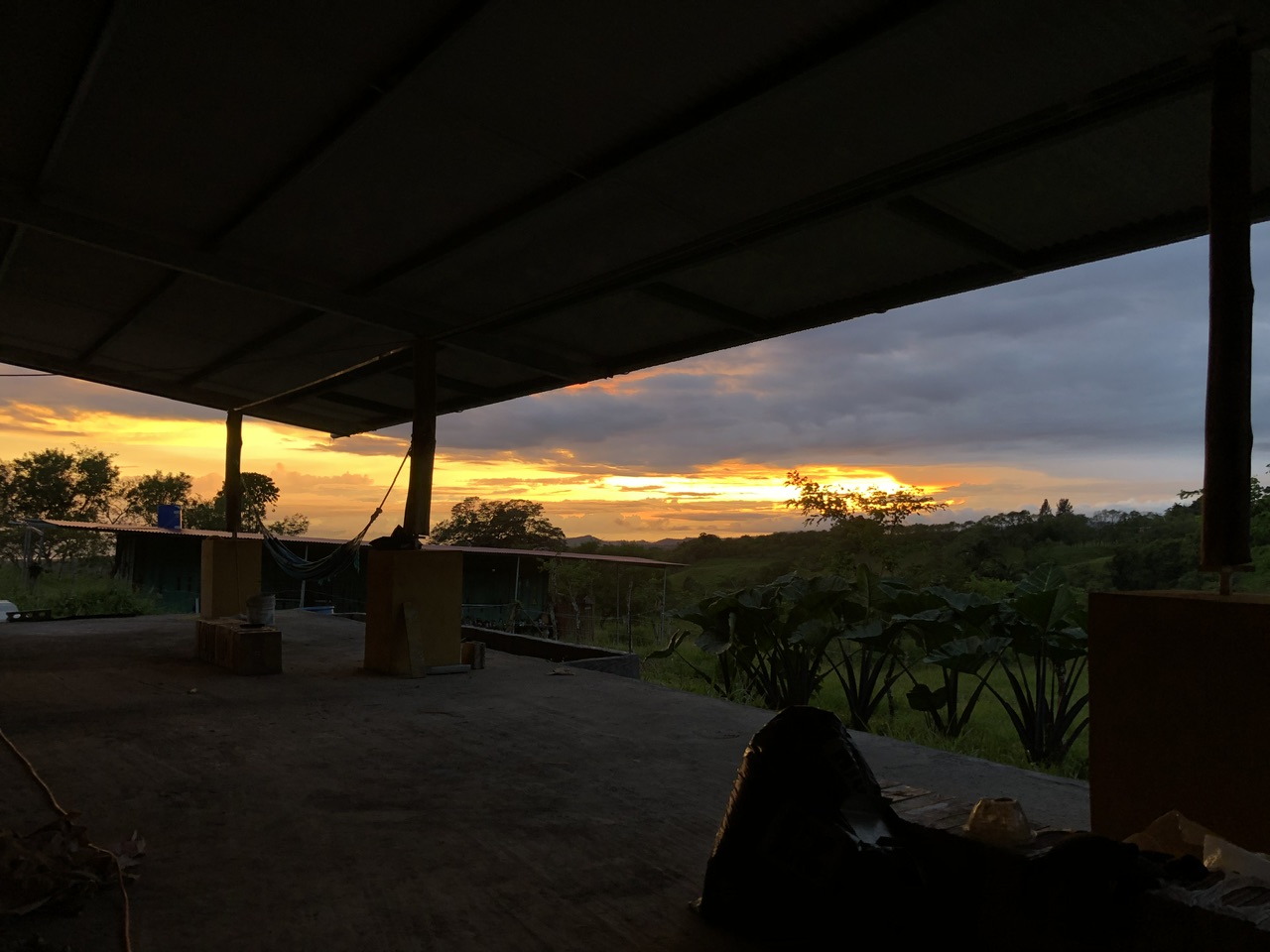
Even though it is not yet finished, I am about to put it on the market. I’m curious how it will be received by those who are coming to retire in Panama… For now, I enjoy my sunrises and sunsets on the big terrace overlooking the pastures with cows and the one or the other horse, and listening to the birds, the rushing of the water of the river bordering my land, and the sound of the rain on the roof when the afternoon showers arrive…

Two of the (to me) most amazing things of the nights here: the hundreds of lightning bugs in the surrounding fields create the flair of magic. And for the first time in over 40 years I am able to see the milky way again, due to the much lower light pollution around here, than  where I used to live in the US and Europe.


Wednesday, September 20, 2023

12 months a year growing season


 Produce grows like crazy here!

Here is a foto from March. On the left side among the grass are small leaves of the otoe. And against the fence in the background, there are the young banana trees visible.

7th of March 2023

Next are fotos of the same otoe plants and banana trees from mid 2023 - a few months later.


12 of August 2023

And now, mid September 2023, the first Banana tree already is bearing fruits and the otoe is taller than me!


20 of September 2023

The growing season is 12 months a year  with vegetables and fruits growing so quickly our grocery bill is going to be quite small, i guess…


Saturday, April 22, 2023

This and that, poco a poco

Since we returned to Santa Catalina on Tuesday, it has been a quite productive time. Slowly, step by step, one outstanding task after the other is tackled.

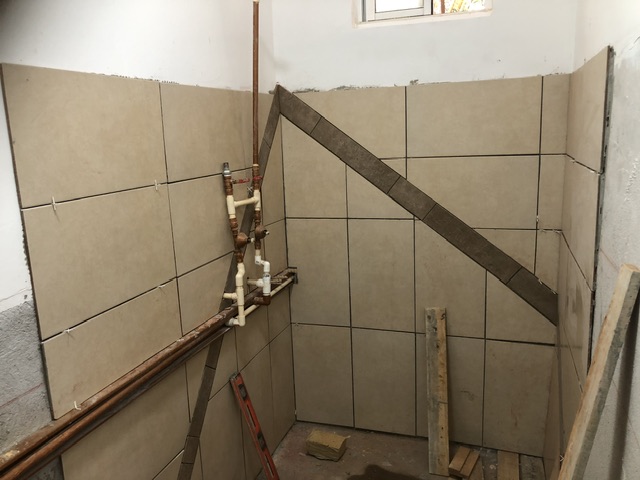
I let me ex brother-in-law inspire me to try to do a little different design with the tiling in the back-room's bathroom. Well, in the mind, it appeared to be not such a big deal. In practice, however... Man! If I had know what I'm getting into with this idea, I would have stayed with the same-old, boring, typical just-slap-them-on design! Turns out I have to cut more than half of all tiles to measure, with various angles. Adding the holes for the water-pipes - aye aye aye! 


Well, today, I didn't do much tiling, though, because the electrician came to finish up the electrical installations. These tasks were weighing heavy on my mind, as I didn't feel I would be able to easily do it myself, should he decide to not come back. Well, he did come back. And he did them all. Yeay!


Hm. Yeay to a degree... It turned out, he didn't install a 10cm x 10cm electrical box, but simply left the conduits end somewhere in the wall. And, he didn't remember where exactly these pipes are. So, he proceeded to use the jackhammer to open the floor along the wall, trying to find them...


Interesting approaches! First he used the steel band that electricians use to pull the wires into the conduit, asking me to try to listen to where about I might here the scratching in the floor. 


Secondly, he proceeded to pour water into the conduit at the breaker-box - hoping that there will be a moist spot, telling us where the pipe might be. after digging around for about 1/2 hour, ruining the floor at a span of about 60 cm along the wall, we noticed a wet spot in the concrete, a few cm further left than where he was digging. So, he dug some more at the new spot, and finally found the tubes. Then he opened the wall to allow for extending the conduits to a height of about 25 cm above the floor, where he created a bigger hole to hold the 10x10 box.

From now on it was all relatively smooth sailing. Pulling the wires, installing the outlets, and done! 

Yeay. He was done! For me the hole mess is left to clean up and fix again! Iris had hired a guy to apply stucco to the walls. Later, I had hired a guy to apply drywall compound on top of the  stucco. And finally another person to sand the hole thing smooth. Finally, I painted the walls with a sealer-primer first, and two coats of paint later. The very expensive, work-intensive wall now had a big gapping cañon! The floor, too, now had a hole in it, that goes all the way to the earth under the concrete slab. I have to fill that hole with slab concrete, then apply topping again, and try to get it all smoothed out again...

So, yes, he was done. But for me the work now just started!!! 🤷‍♂️😩


But, hey, I'm not complaining - at least not too loudly! He did hook up the electrical installation in the back-room with the breaker-box. So now we can use the outlets there, and I can install the light as well... 🤪


Once he left, I was in good spirits, so I glued the tiles I had cut to measure last night. 


Then I decided to fix another problem the electrician created for us: there are no outlets on the terrace! Well, local folks don't have a terrace, and if they do, don't care about electricity out there! "Somebody else might come and steal electricity by plugging in an extension cord! So best not to have outside outlets!"

Well, we want outlets out there!

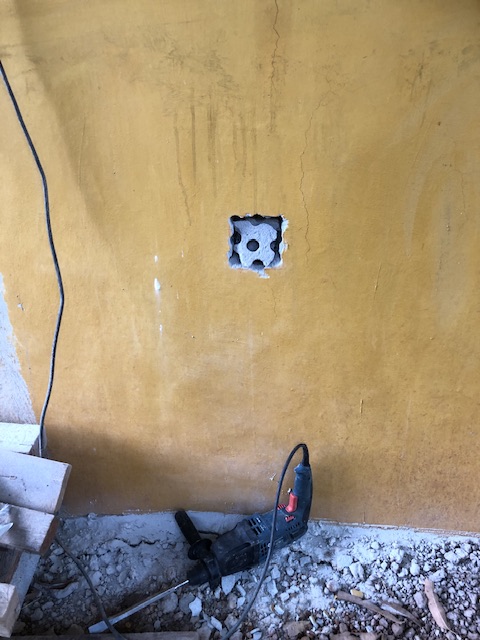
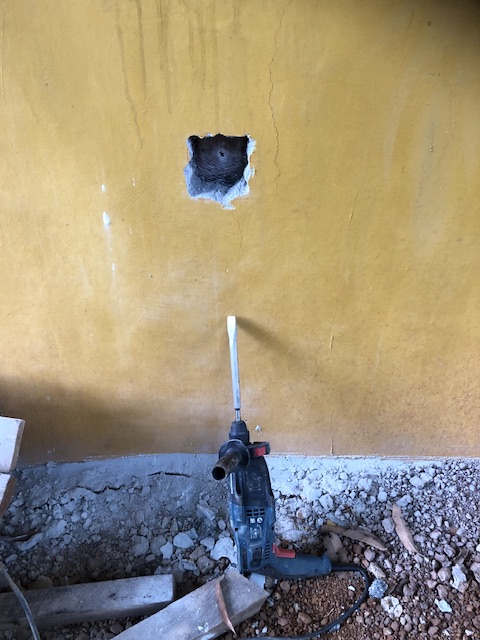
I opened the outlet box in the living room, that is in the wall to the terrace. From there I drilled a hole to the outside, so I know where to create the hole for the 10x10. Trying to not make a huge hole like the electrician did, I drilled a few priming holes with the hammer drill, then sed the chisel to cut out the hole. See for yourself the difference!


Center hole as pilot drilled from the enter of the outlet box inside 

More pilot holes to outline the hole for the box

with the chisel now "cutting" out the 10x10


inside, the back of the 10x10 box of the inside outlet is visible

Hole is ready
10x10 cm (4x4") outlet box inside


A connector on the inside box, anther on the new outside box, and a tiny piece of conduit to connect them and run the wires from the inside to the outside. One connector needed to be shortened a little bit, so the 10x10 is flush with the outside wall...

Used some leftover Romeral to start filling the holes. Once that is dry in two or three days, I might need some more cement, or be able to directly apply the drywall compound... we'll see. The large hole in the floor left open will need more cement later, too...

By now the sun was setting, so I left the rest for tomorrow: installing outlets outside, connecting them to the outlets inside, and adding a switch inside, with which I can turn off the electricity for the outside outlets. Darn! There the neighbors already were rubbing their hands anticipating to steal electricity, and this damn gringo foiled their plan!!!

Well, all in all, it was a productive day again! Electricity all done (aside of the outside outlets which I can do myself), tiling progressed a little, too!

Tomorrow's another day... for today, let me clean up and head ot the restaurant. Maybe there will be guests again today, with whom I can have another of my typical inspiring conversations...


Saturday, November 26, 2022

Hostal un Mundo

 Originally, Iris planned to rent out rooms in her house to locals. 

The hotels around here need more workers than are available in the village, so many people are commuting here to work. Early in the morning you can see several pickup trucks with the truckbeds full of people arriving. And the early morning busses (arriving at 6:30 and 7:30) are often full, too. The problem, though, is getting back home. The last bus leaves at 5:00, so those who want to (or could and would be needed to) work in the evening would be stuck here, with no place to sleep. 

Iris wanted to fill that need.

However, when trying to find accommodations for our guest-workers from Chiriqui we realized, that there is nothing available for guests on tight budgets as well. Most of the hotels are in the 50 to 140$ per night range. The two hostels in town, that are renting beds in mixed dormitories, are also almost 20$ per bed per night.

https://drive.google.com/uc?export=view&id=1XAjXBM4h1mmutvc3u6FB-9n_gTQDsWaP

So we thought, maybe we can provide a mix of less expensive beds for guest and local workers as well. Even though the house is about 20 min walk from the beach in the village, we think, some backpackers and youngsters might prefer to save a few dollars on the bed and walk, rather than paying premium prices for 15 min closer to the beach... 

We'll see... For now, we're thinking (hoping) that between locals and thrifty foreigners, we're going to be able to have enough business to have the house pay for itself over time...

With the change in plans for the purposing, the floorplan of the upstairs changed as well. And the ideas about the landscaping around the house too.

Instead of another kitchen and 3 bedrooms upstairs, we're now thinking of making just one big room, and four toilets plus two showers for guests to share.

Instead of using blocks to build the outside walls, we're planning on using locally sourced wood on the side, and mostly glass on the front and backside.

But, all that will have to wait for now. First, we have to get the downstairs ready!


Sunday, January 30, 2022

Planning my new home

 I have come to decide on two potential properties among which I'll choose "the one"! Both of them are land without buildings. I'll build my own home.


The disadvantage is, that I'll have to rent somewhere until the home is ready for me to stay in. However, this disadvantage has no teeth, since Kyle's Bugaba Highland guestroom is super nice, and close to where I'll be building.

The advantage is, that I can try out all kinds of ideas!

Most likely, I'll get a piece of land in an area where it is a bit warmer, but not as hot as in David, or on the coast. That means, I might be able to get by without air-conditioning - if I am careful about heat management.

I think I want to have the roof open on the very top for the whole length of the house. On top of that gap I'll add 50cm higher another roof that covers the opening. That way, it doesn't rain in, but hot air raising to the top of the house can exit and doesn't build up under the roof.

Secondly, I'll only have the bed- and attached bathrooms walled in, and bug proof. Once the sun goes down, one retreats inside to turn the light on. Bugs, attracted to the light, will stay outside. 

The kitchen will be an outside kitchen, which together with the living space makes up the big terrace under the roof. About 3/4 of the space under the house's roof is terrace and kitchen! Mosquitoes are not so much a problem in this area, neither are there any sort of dangerous animals, from which one has to protect oneself. 

There's an outside kitchen on the big terrace under the roof here at Kyle's. I've been using it for 3 months now, and it was awesome! I'm always outside. Except in the evening, when I need light or when I am sleeping - then I'm inside of the room which the insect screen makes bug-free.

The locals are building everything with blocks and concrete. Well, that is easy to do, and is pretty much resistant to any kind of weather or condition - except earthquakes. The problems I do see with this - aside of the earthquakes - is, that any repairs or changes are very hard to do. You have to employ a jack-hammer. Secondly, due to the high humidity all the time, you have to repaint all walls every 2 or three years. And, stone feels dead and emotionally cold.

I am going to be owning 2 1/2 ha of teak plantation, where every 4-5 years some of the trees have to be removed, to make more light available for the remaining trees. That means, every couple of years I'll be having a ton of teak wood, with which I would need find something meaningful to do. Teak is a rather insect and rot resistant hard-wood. So, I am thinking of trying to build the walls (and ceilings) in my house out of my own lumber. Even the frame that holds the roof could be made from this lumber.

I still have to figure out how I get the trees from the plantation to my land, and how to transform them from logs to lumbar. Maybe I contract this task out to one of the many small sawmills in the area. Or maybe I'll bring a bandsaw and do it myself... But, that will show, too... 

People around here have problems with lightnings taking out various electronic equipment, even appliances. I want to learn about lightning-rods, and hopefully install a lightning-rod that will protect my and my neighbors homes.

The windows used around here are very low quality, do not keep bugs out reliably, and can only be opened to have 45% of the window space be open. They are sliding windows - mostly sliding side-ways. So more than half of the opening is blocked by the sashes.

I would like to try to build my own windows. There are two types I'm thinking of:

* Sliding sideways onto the wall space besides the window

* Tilting upwards and secured on the ceiling

Both windows would have the frame with the glass not be inside of the window-opening. Instead, there would be a frame with insect-netting there (removable, off course; so it's easy to fix when needed). The frame with the glass would be on the inside of the room, sliding along the wall with the window-opening, and slightly bigger than the opening. So, when closed, it is pressed against the window-frame, not inside of the window-frame.

The tilting window would require ropes and pulleys to make it easy to open and close the window. 

For both types I need to think about how to best lock them, for when 'm leaving the hosue cannot be broken into too easily.

The goal of these windows is to get as much air circulation as possible into the rooms! Air circulation seems to be the only measure that prevents mold and mildew buildup.

I want to install wall-mount toilets and vanities. The cost for such toilets is much higher - probably 1500$ a piece, compared to 150$ for a floor mount one. But, I feel, it is worth it over time to be able to easily clean the floor of the bathroom. Wall mount vanities are not easy to find either. But, I thnk I should have enough wood to be able to build them myself.

There won't be bathtubs - to me just a waste of hot water! - instead there'll be only showers. Those, however are roomy - maybe 150 cm by 180 cm (5' x 6'). The floor of the bathroom is about 5 cm (2") lower than the rest of the house, and it is slightly sloped towards the shower drain. That way, I can simply hose down the floor and be done with it!

The local septic systems don't even deserve that name! They are basically a container with an incoming pie and an outgoing pipe. Everything falls in on the one side, and sits there. Once the container fills up, whatever is too much runs out the other side.

I want to do a better system. I'm thinking of implementing a three chamber tank, which then empties in a holding tank, from which the fluid is discharged periodically via a mini flashflood onto a vertical-style clearing field. The water draining out of that clearing field should almost be drinking water quality. So, it should be safe to use in the garden for watering, or when it gets into a river.

Also, I would like to collect and treat rain-water. No chemical or energy using treatment, but simple, natural filtering.

The system consist of three tanks: First tank simply collects the rain water. It is a buffer. It discharges water through a smallish pipe (5cm, 2"?) into the second tank. That one is filled with gravel and sand, similar to the clearing field. The microbes developing in that filter will clean out most of the stuff that's in the water (like bird-poop and other stuff that the rain finds on the roof). The bottom of this tank now drains into the third, the actual water holding tank.

I'm hoping to use this water for showers, toilet, and garden watering.

The hot water for the showers I'm planning on heating using some sort of solar-collectors on top of the roof. Currently, I'm thinking a simple hose laid in serpentines on the roof should suffice. I'll have to play with how big a hot water tank I'll need, and how much hose is needed to reliably heat the whole tank.

There are many more details to be thought through: exact makeup of the walls, how and where to but the wiring, how to get the heavy lumbar for the house frame in place (there seem to be no cranes like in Europe, and everything is done manually), and much more... Since I am not building the typical, traditional style, there are no common best practices available. That means, I have to think up everything - from the overall big-picture ideas, down to the very gory details...

A lot of brain work. But also a lot of fun!


Sunday, August 15, 2021

Free as a bird - but what direction to choose?

During my June trip to Panama I firmed up my decision to not go back to work (at least for now), but to retire early. I have a little money left from the sale of the house last year, and a condo in Atlanta, which I am planning on selling next year. Together, the funds should suffice to buy a little property and sustain my life until I can start drawing my retirement annuity in two years. Together, it should allow me to postpone drawing SS until I am 67 (maybe longer, maybe not quite as long).

So, in essence, if I am very thrifty for a few years, I can retire now, and start working on my dream already!

Yeay!


But, wait! Which of my dreams? 


There are several options that sound absolutely awesome to me! I now have to make a very hard decision which of the possible lives I would want to lead.

1. Reforesting a piece of land

We hear about vast areas of land being deforested every day all around the globe. But there are also reports of reforestation projects. Panama, for example, has the declared goal of reforesting 1 million hectares ( 2.5 mill acres) by 2035. This is a report (in German) about a retiree in Turkey, who converted a landfill into a forest. And, of course, there's the awesome story of the photographer Sebastião Salgadoand his wife in Brazil.

I LOVE trees! The idea of buying a finca with a couple of hectares of former forest now (probably degraded) pasture, and spending my retirement years just planting trees, fills my heart with joy!

I've done some online searches and there appear to be properties of a reasonable size and price available. So, this is definitely a feasible option. 

https://drive.google.com/uc?export=view&id=1eXKNHO9atYyIJLWLexaW4gQaupzQnoxM


2. English tutoring for locals

English is the de facto lingua franca. Any knowledge available in this world today is available in English. Some of the knowledge is available in German too, some in French, some in Chinese, and so on. But, for every other language it is only a part of the information that is available. Also, with most of international cooperations and projects, english is the common language that is being used.

I think, for any kid in this world today, who does not speak english, the world is not open. I was able to make something with my life by having been able to migrate from my home country to the US. Today, migrating is not necessary anymore - as long as there's internet and the ability to communicate in English, there are possibilities!

I've overheard some university level english classes, where the teachers had a terribly strong accent, and made many mistakes. I could imagine that on highschool level and even more so primary school level, the quality of english education is even less. Having access to another person to practice and experience is very important!

I do not like cities, but prefer rural areas. As everywhere, in rural areas it is even harder for locals to find good english tutoring options. Also, there seems to be a two class society, where indigenous folks get less opportunities than citizens of european, asian, or north-american descent. 

So, I think, I could make a real difference by offering english tutoring, especially to indigenous kids. 

Tutoring english has been on my mind for a while. I took an ESL Teacher certification program at University of North Georgia 2 years ago, already in preparation of this idea - offering english conversation and general language tutoring to locals.

This, too, is a very feasible option, that also warms my heart.

https://drive.google.com/uc?export=view&id=17MQGAfBZzCm7i5kit7XsRTtp9okA9HTz

3. "my conversations"

I find myself very, very often in a situation, where the insights I have been given over my life-time are of great interest to people who just happen to show up in my life. Be it as seat neighbors in an airplane, at a coffee-house, on social media, in a park... anywhere, any time!

Going to Panama in June I anticipated not being able to have any conversations like this, due to the language issue. However, I soon realized that this concern was unwarranted! 

My first stay was at the Bhodi Hostel in El Valle de Anton. There I found a very diverse mix of nationalities and ages among the guests. And, plenty of instances where "my conversation" was happening.

It occurred to me, that if I were to organize a hostel then guests from all over the world could show up. I would be, essentially, "available" for the Universe to arrange for people to show up who need the information I'm able to provide.

Later, it dawned on me, that I don't even have to operate the hostel myself, but could just live close to a hostel, and every now and then, when I feel like it, go there for breakfast or dinner, and make myself available that way.

El Valle is a lovely town, and at a perfect elevation - temperature-wise. It has a great market and supermarket, it's very quiet and peaceful (off the main-street; but even on the main-street the traffic is nothing to worry about). 


There are several homes and properties for sale there. I found one online, which looks promising. So, this, too, is quite a feasible option.

https://drive.google.com/uc?export=view&id=1ZiGoXf4u5Mr6a4UnlY396bp_KIsIgALq


As of now, I have no clue which of these options it will be. I keep flipping back and forth between them! 

I guess, it will clarify once I go back to Panama. As I always recommend to folks: let the Universe guide! Instead of me firming up plans based on my thoughts and knowledge (which is, of course, less than a fruit-fly poop spec!), be open minded and on the lookout for what is coming my way!


I love to ponder ideas, and to know what I am working towards, and then getting to work on it! Right now, I can't do that, as I have no clue what I'll end up doing. That makes it very difficult for me! On the other hand, there are so many loose ends I have to tie up where I am, that if I can focus on working on those, I'd soon be really free as a bird! 

So, I guess, I'll just do that: get my stuff here together and settled. Soon enough, I'll be in Panama again, and things will develop...


PS: For those of you, who do not know about my world-view (which is guiding all my life decisions and goals): it is explained here

Sounds that keep you awake at night

 We had a guest check out early, today. She lamented she wasn’t able to sleep. Too much sounds of nature! Big windows with just insect netti...